

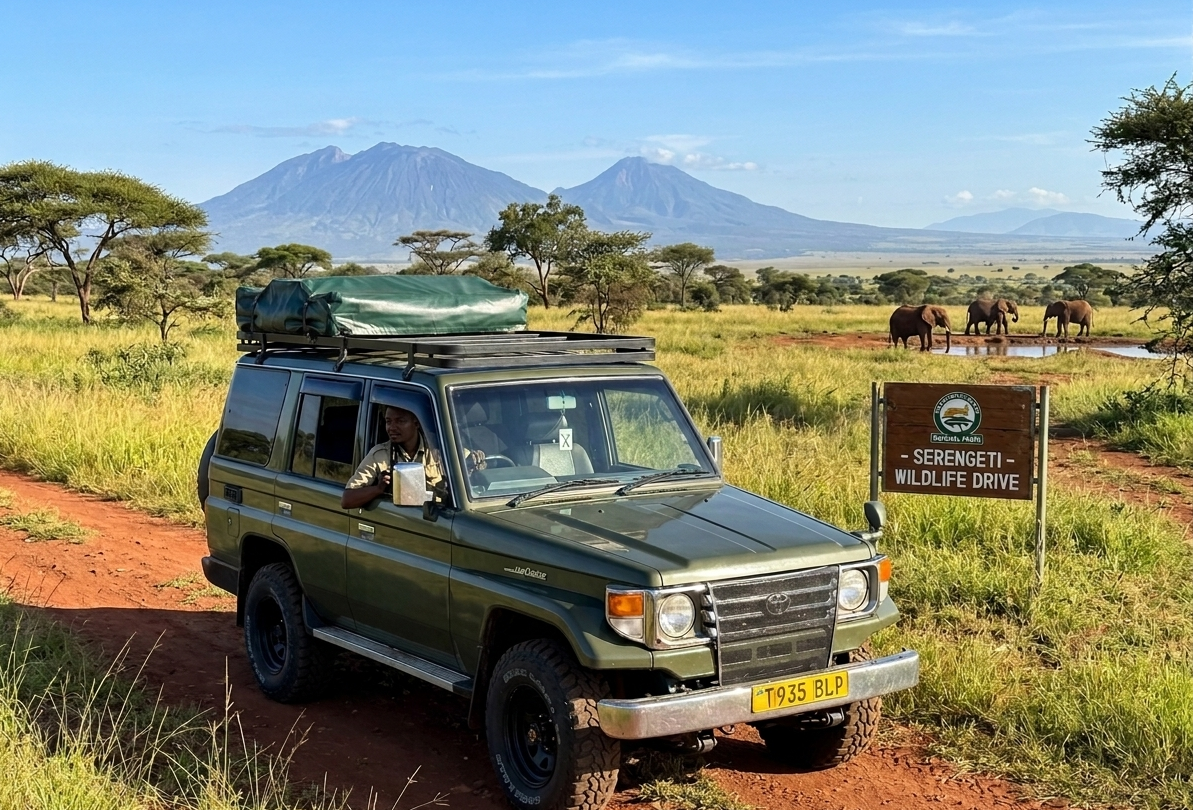
Drive deeper. Stay longer. Explore Tanzania at your own pace.
There is something different about exploring Tanzania from behind the wheel. Instead of following a fixed schedule, a Tanzania self-drive safari gives you the freedom to decide when to stop, how long to stay at a viewpoint, where to camp for the night and which roads to take. One morning you might be watching elephants beneath the baobabs of Tarangire. The next, you could be crossing the highlands toward Ngorongoro, with the Serengeti stretching ahead of you.
But a self-drive safari in Tanzania is not simply a matter of hiring a car and following Google Maps.
The distances are long. Roads can change with the weather. National parks have their own regulations, gate times and conservation rules. A proper safari vehicle, realistic route planning and local support can make the difference between an unforgettable adventure and an unnecessarily difficult trip.
This guide explains how to plan a Tanzania self-drive safari, what vehicle you need, where you can go, what to pack and how to make the most of your time on the road.
What Is a Tanzania Self-Drive Safari?
A self-drive safari means you drive your own safari vehicle, rather than traveling with a private driver-guide. You remain in control of the journey while using a properly equipped 4×4 designed for Tanzania’s roads and safari conditions.
Depending on your itinerary, you can combine:
- National parks
- Wildlife areas
- Scenic mountain and highland roads
- Remote campsites
- Lodges and tented camps
- Local villages and small towns
- Longer overland routes
For travellers who enjoy independence, photography, camping and adventure, it offers a very different experience from a conventional organised safari.
TANAPA confirms that self-driving is possible in many national parks with suitable vehicles, while stressing the importance of checking current rules, road conditions, gate times and regulations. Off-road driving is restricted unless specifically permitted.
Why Choose a Self-Drive Safari in Tanzania?
- You control your own pace
You do not have to follow somebody else’s timetable. Want to spend another hour watching elephants? Stay. Want to stop for photographs? Stop. Found an interesting viewpoint? Explore it. That freedom is one of the biggest attractions of self-drive travel.
- Your safari becomes your own adventure
A self-drive trip feels less like a packaged holiday and more like an expedition. You are not simply being transported between destinations. You are part of the journey. The road becomes part of the experience.
- It is ideal for independent travellers
Self-drive is particularly attractive to:
- Couples
- Friends traveling together
- Families with older children
- Photographers
- Adventure travellers
- Experienced 4×4 drivers
- Overlanders
- Travellers who prefer camping
- Visitors looking for a private safari experience
It can also work particularly well for travellers who want to combine camping and lodges, rather than committing to one accommodation style throughout the trip.
What Vehicle Do You Need for a Tanzania Self-Drive Safari?
This is one area where you should not cut corners. A normal city rental car is not the right vehicle for a safari. You need a proper high-clearance 4×4 suitable for rough gravel roads, corrugations, mud and uneven terrain. For a serious Tanzania safari, a well-equipped Toyota Land Cruiser or equivalent 4×4 is a strong choice.
Important equipment can include:
- 4WD capability
- High ground clearance
- At least one full-size spare wheel
- Recovery equipment
- Jack and wheel-changing equipment
- Basic tools
- First-aid kit
- Communication equipment
- Reliable navigation
- Camping equipment if you are camping
- Rooftop tent where required
- Refrigerator or cooler
- Additional water storage
The vehicle should be prepared for the route you are actually planning, rather than simply being described as a “4×4”.
Why the Land Cruiser?
The Toyota Land Cruiser has become one of the most widely used safari vehicles in East Africa because it combines high ground clearance, durability, 4WD capability and good availability of parts and mechanical support.
For self-drive travellers, the important question is not simply “Is it a Land Cruiser?
Ask:
Is the vehicle properly prepared for a safari? That is much more important.
The Best Places for a Tanzania Self-Drive Safari
Tanzania has several excellent destinations for independent travellers.
Tarangire National Park
Tarangire is an excellent introduction to Tanzania’s northern safari circuit.
The park is famous for its elephants, large baobab trees and seasonal wildlife concentrations around water.
It is also relatively accessible from Arusha, making it a practical first safari destination.
TANAPA places Tarangire roughly 2.5 to 3 hours by road from Arusha under good road conditions, with graded roads inside the park. A 4×4 is particularly recommended during the wet season.
Best for: elephants, baobabs, photography and a relaxed start to a safari.
Lake Manyara National Park
Lake Manyara offers a very different landscape. The park combines groundwater forest, open woodland, grassland and the lake itself. Its location near Mto wa Mbu makes it an easy addition to a Northern Circuit itinerary.
TANAPA places the park approximately 125 km from Arusha, with a journey of around 2 to 2.5 hours by road under good conditions.
Best for: varied landscapes, birdlife, elephants and combining with Ngorongoro.
Ngorongoro Conservation Area
Few places in Africa compare with the landscape of Ngorongoro.
The enormous volcanic caldera creates an extraordinary wildlife environment, while the surrounding highlands provide some of Tanzania’s most spectacular scenery. Ngorongoro is particularly important for self-drive travellers to understand because its rules and operating arrangements differ from ordinary road travel.
The NCAA also stresses that off-road driving is strictly prohibited within the conservation area. Before traveling, confirm the current access, vehicle and permit requirements for your itinerary.
Serengeti National Park
For many travellers, the Serengeti is the main reason to undertake a Tanzania self-drive safari. The landscape seems almost endless. Golden grasslands, rocky kopjes, acacia trees and enormous open plains create the setting for one of the world’s greatest wildlife ecosystems.
And this is where preparation matters.
The Serengeti is huge. Distances can be considerable, roads can become challenging and wildlife sightings are unpredictable. Do not plan your Serengeti itinerary as though you are traveling between cities on a paved highway. Build your route around time, daylight, road conditions and realistic driving distances.
TANAPA’s published Serengeti guidance emphasises staying on designated roads, respecting speed limits, observing park hours and avoiding disturbance to wildlife.
A Typical Tanzania Self-Drive Safari Route
For a first trip, a Northern Circuit route can look something like:
Arusha → Tarangire → Lake Manyara → Serengeti → Central/Northern Serengeti → Ngorongoro → back toward Arusha
A longer journey could incorporate additional destinations such as:
Arusha → Tarangire → Lake Manyara → Ngorongoro → Serengeti → Lake Natron → back toward Arusha
Or, for experienced travellers:
Arusha → Northern Circuit → Central Tanzania → Ruaha → Nyerere
The best route depends on your available time, season, driving experience and whether you want camping, lodges or a combination of both.
How Many Days Do You Need?
5 – 7 days: Good for a shorter Northern Circuit adventure.
You can concentrate on Tarangire, Ngorongoro and part of Serengeti.
8 – 10 days: A much better option if Serengeti is a priority.
You have more time to absorb the journey instead of spending every day driving long distances.
12 – 14 days: Ideal for travellers who want a more complete Northern Circuit experience.
You can spend longer in Serengeti and build some flexibility into the itinerary.
2–3 weeks: This is where self-drive really starts to feel like an expedition.
You can combine several parks and landscapes and include more remote areas without having to rush.
Self-Drive Safari: Camping or Lodges?
There is no single correct answer. Rooftop Tent Camping, Camping gives you maximum independence.A properly equipped vehicle can allow you to carry:
- Rooftop tent
- Mattress
- Sleeping bags
- Cooking equipment
- Table and chairs
- Water
- Food
- Refrigerator/cooler
- Lighting
- Basic recovery equipment
It also puts you much closer to the landscape. But camping requires more preparation. You need to understand where you can camp, manage food and water properly and be comfortable operating independently.
Lodge-Based Self-Drive
You can also rent a safari-ready vehicle and stay in lodges and tented camps. This gives you the freedom of self-drive without requiring you to carry a complete camping setup.
The Best of Both
For many travellers, a combination works extremely well. Some nights camping. Some nights in comfortable lodges. This gives you the adventure without making the entire trip dependent on camping.
What Should You Pack?
A good self-drive safari packing list should include:
- Driving essentials
- Driving licence
- Passport
- International Driving Permit where required
- Rental documentation
- Insurance documents
- Navigation/GPS
- Offline maps
- Phone and power bank
- Safari essentials
- Binoculars
- Camera
- Extra batteries
- Memory cards
- Sun protection
- Hat
- Sunglasses
- Insect repellent
- Reusable water bottle
- Headlamp or torch
- Clothing
Choose comfortable, practical clothing and bring layers. Early mornings and evenings can be surprisingly cool, especially around the Ngorongoro highlands, while daytime temperatures can be warm.
TANAPA’s current visitor guidance also recommends sufficient water, sun protection, appropriate clothing and basic safety items.
Is Tanzania Self-Drive Safe?
Yes, with proper preparation and responsible driving. But a safari is not the same as driving in a city. You are sharing the environment with wild animals. You may encounter elephants on or beside the road. Buffalo can be unpredictable. Roads can be muddy after rain. A vehicle problem far from the nearest town can become a serious inconvenience.
The basic principles are simple:
- Drive slowly.
- Stay on permitted roads.
- Respect wildlife.
- Never assume an animal will behave like a domestic animal.
- Do not leave the vehicle except where permitted.
- Avoid driving after dark in areas where it is not permitted.
TANAPA’s guidance emphasises road safety, designated tracks, speed limits, wildlife protection and following park instructions.
What About the Rainy Season?
Do not automatically rule out the rainy season. Tanzania can be spectacular during the green season, with fewer visitors in some areas, dramatic skies, fresh vegetation and excellent photographic conditions. But roads can become muddy and conditions can change quickly.
This is exactly why the choice of vehicle matters.
TANAPA specifically advises visitors to expect muddy sections in wet conditions in parks such as Tarangire and to use suitable 4×4 capability.
For self-drive travellers, the golden rule is:
Plan for the conditions you might encounter, not only the conditions you hope to find.
Self-Drive Safari vs Guided Safari
Neither is automatically better. It depends on what you want.
| Self-Drive | Guided Safari |
| · Drive your own vehicle
· Greater independence · Flexible pace · Ideal for adventure travellers · More planning required · Great for photographers · Camping or lodge flexibility
|
· Professional driver-guide
· Less responsibility · Expert wildlife knowledge · Excellent for first-time visitors · More logistics handled · Experienced wildlife spotting · Usually fully organised |
A self-drive safari is particularly rewarding if the journey itself is part of what you are looking for. If your priority is simply seeing as much wildlife as possible with minimal logistical responsibility, a guided safari may be the better choice.
Start planning your Tanzania self-drive safari today.
Explore Tanzania by 4×4